scroll down for more content
OCTOBER 2-4 2026
PHOTOBOOK WORKSHOP
Led by MICHAEL ACKERMAN and TOMASZ LACZNY
An intensive workshop in photobook creation.
What three days actually looks like, below.
Location:
Brooklyn Grain
75 Stewart Avenue, Suite 404
Brooklyn, NY 11237 NEW YORK
Limited to 14 Participants
$700
Includes:
3 days of intensive training
led by two tutors
over 20 hours
practical exercise bookbinding exercises
FAQs
Overview: 3-Day Workshop (New York, Brooklyn Grain 75 Stewart Avenue, Suite 404 Brooklyn)
Dates: October 2–4, 2026
Schedule Overview
Friday, October 2 (Start: 10:00)
10:00–12:00: Introduction to the tutors, overview of photobook-making, and examples of handmade books.
12:00–13:30: Participant project introductions.
13:30–14:30: Lunch break.
14:30–15:30: Editing and visual narration introduction.
15:30–17:30: Group and individual editing sessions.
Saturday, October 3 (Start: 10:00)
10:00–13:00: Group and individual editing sessions.
13:00–14:00: Lunch break.
14:00–15:00: Introduction to bookbinding, bookbinding techniques.
15:00–16:30: Stitching exercises.
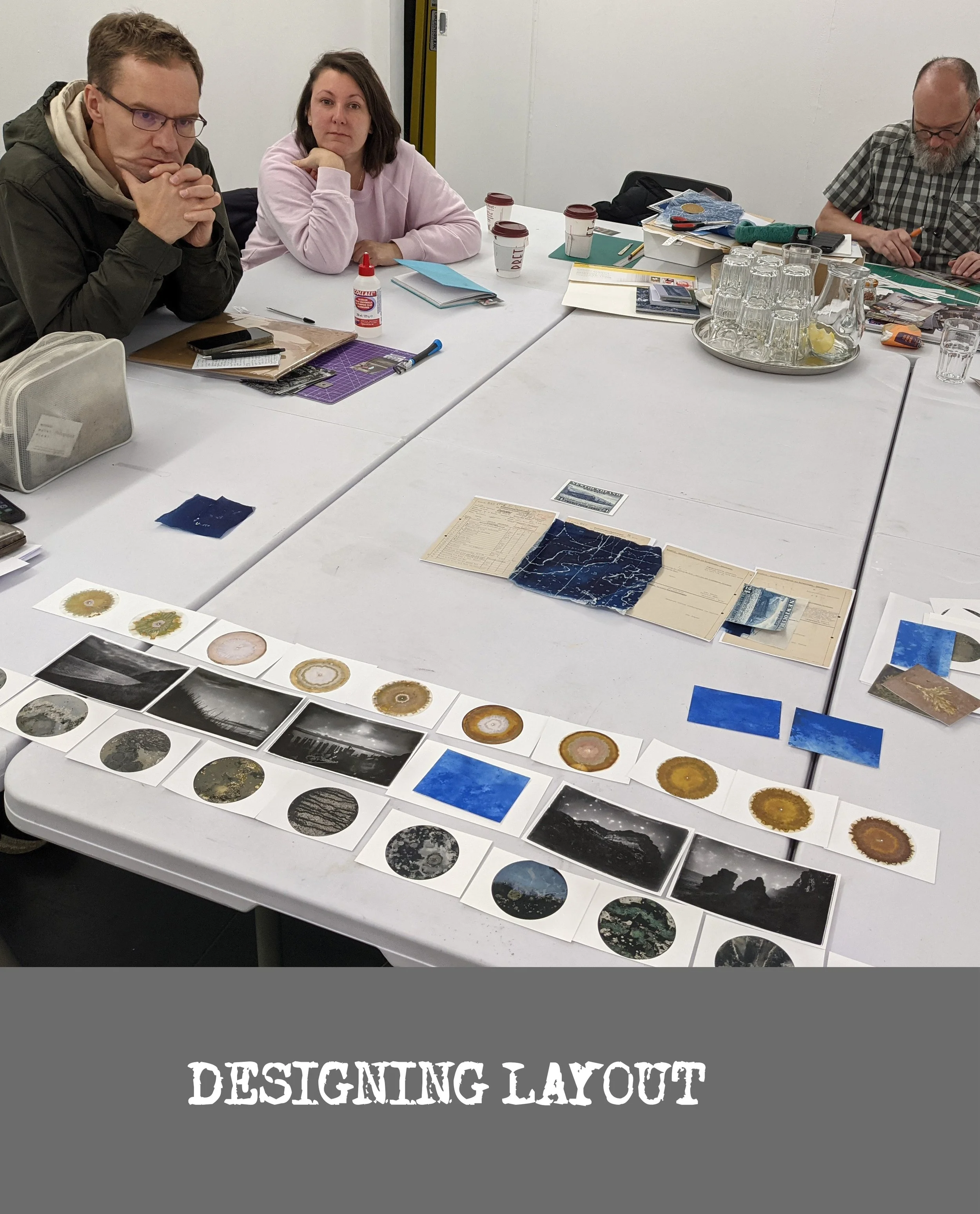
16:30–17:30: Introduction to designing layout.
Sunday, October 4 (Start: 10:00)
10:00–11:00: Introduction to designing covers, with examples.
11:00–13:00: Individual work on book dummies.
13:00–14:00: Lunch break.
14:00–16:00: Continued individual work on book dummies.
16:00–17:30: Final presentations by participants.
In Depth
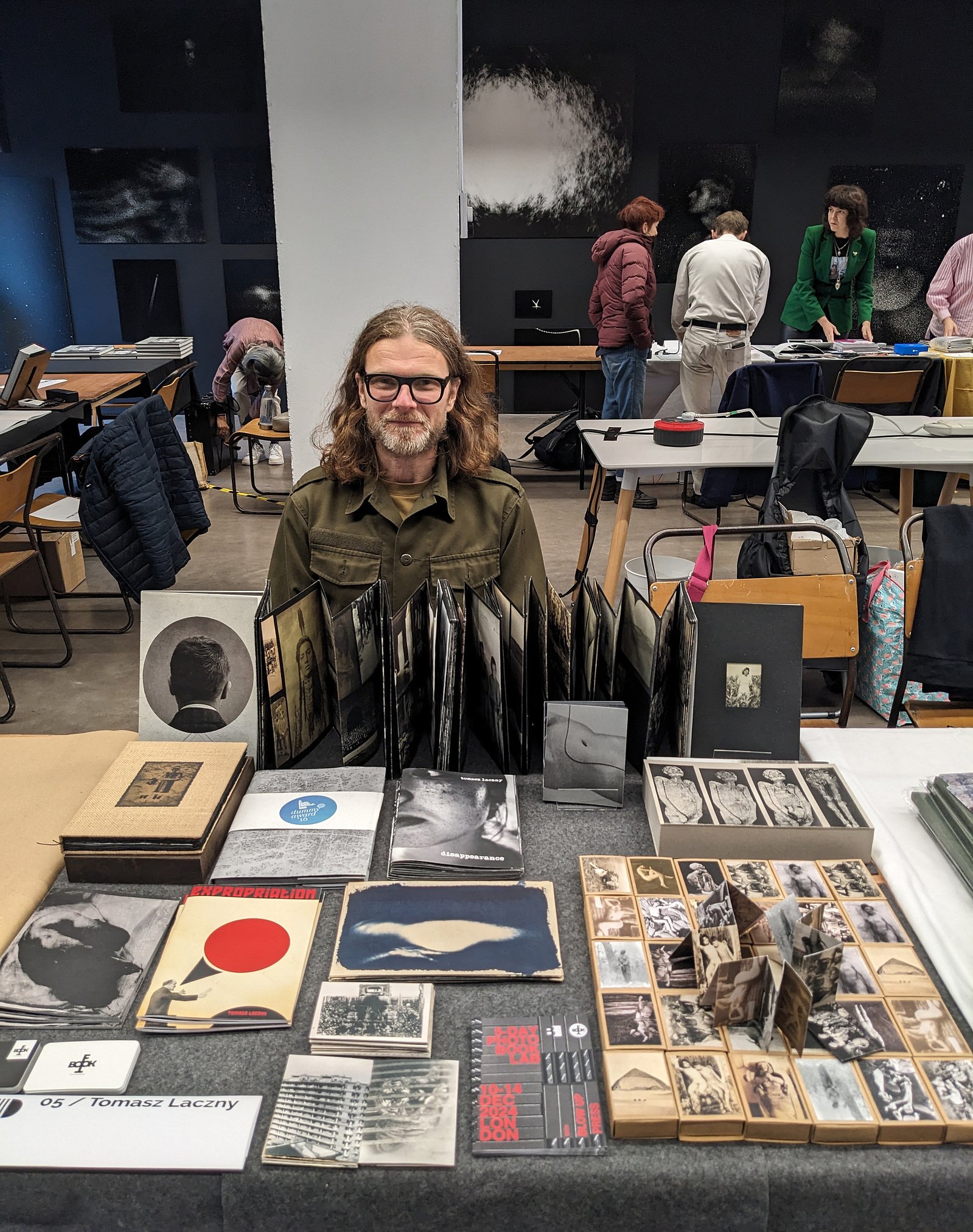
Introduction to the tutors, overview of photobook-making, and examples of handmade books. Michael will introduce his photographic practice, focusing especially on his books. He'll show a few of his dummies — something he rarely does. Tomasz will show his handmade books, focusing on his personal projects as well as samples of books he's designed for other artists.
Participant project introductions. Each participant briefly outlines the project they're working on. This is done without showing images — the idea is to verbalise the core of the project and to bond with the rest of the group.
Editing and visual narration introduction. Michael and Tomasz talk through their approach to editing, show some examples, and introduce a bit of the theory behind editing.
Group and individual editing sessions. Each participant has their project edited by the tutors. We'll discuss different approaches and possibilities for arriving at an edit aligned with the core principles of the project.
Introduction to bookbinding, bookbinding techniques. We'll cover the basics of bookbinding and give practical examples of how creatively binding can be used to support the core of your story.
Stitching exercises. We'll cover pamphlet binding and Japanese binding, as well as the principles of signature binding. After the workshop, participants will be provided with instructional videos.
Introduction to designing layout. A demonstration of the basics of layout design. Using three different image sizes, we'll show you how to quickly assemble a working dummy to assess the relationship between images, and the flow and rhythm of the book.
Introduction to designing covers, with examples. The principles will be covered with real-life examples.
Individual work on book dummies. This is where you'll create your own dummy based on everything covered earlier in the workshop. Each participant will be guided by both tutors throughout the exercise.
Final presentations by participants. All participants present their finished dummies to the group, receiving feedback from the tutors and the rest of the group.
Why Participate?
This workshop isn't only for those putting the finishing touches on a project. If you're still in the middle of shooting, that's fine — perhaps even better. Working with material that isn't yet resolved can sharpen how you see it. The editing sessions are designed to help you understand what you actually have, not just what you intended.
Why Make a Dummy? There are things a screen won't tell you. Holding pages, turning them, feeling the weight of a sequence in your hands — this changes how you see your work. A physical dummy makes decisions visible that would otherwise remain abstract: pacing, rhythm, the space between one image and the next.
Paper Paper is not neutral. It carries light differently, absorbs it differently, and changes how an image feels to look at. Choosing the right paper is one of the quieter decisions in bookmaking — and one of the most consequential.
Size and Format The dimensions of a book determine the kind of attention it asks for. A small book pulls the reader close; a large one keeps a certain distance. Neither is better, but both mean something. Binding, too, is part of this — it shapes how the book opens, and how it's held.
Design and Photography Design shouldn't be an afterthought, and it shouldn't overpower the images either. At its best, it's invisible — it simply lets the work be seen on its own terms.
Whether you're beginning or nearly done, the aim is the same: to leave with a clearer sense of what your book wants to be.
Testimonials:
"The workshops Tomasz runs are truly enlightening. They are that rare combination of practice, theory, and something else I'd name intuition, but which sometimes feels almost mystical. He gives time and emotional energy to each project, and helps the artist at whatever level to think and rethink their images in the context of visual narration and as part of the material process of making something, stitching and sticking and cropping. On occasion to even enter the rare rhythm of a fluent visual storyteller - a quality which he personally always seems to possess. Tomasz's processes are both intellectual and physical, and the outcomes I witnessed were always inspiring: suggestive of more thoughtful future works to come. Tomasz makes us look at the book, and the art book, in new ways. An exciting and fulfilling exercise."
Robin Hunt -- participant of 2023 workshop organised by Photobookcafe London
“This workshop with Tomasz allowed me to really put a new work in motion – his generous and precise insight brought a fresh dynamic as well as a new formal approach to the pictures. Since, the project has been shown in two exhibitions and has received a grant to produce the book!”
Matilda Holloway -- participant of 2019 workshop organised by Espace Saint-Cyprien Toulouse 2020
“This is exactly what I expected as a workshop, constructive with a listening group, and a first book’s draft Tomasz understands right now and pays attention to everyone. He's full of ideas and knows how to give each one of the tips that match his project perfectly, with a great organization. Thank you. It was great.”
Daniele Boucon -- participant of 2019 workshop organised by Espace Saint-Cyprien Toulouse 202
About the Workshop
This all-analogue workshop requires no prior knowledge of editing software. It covers:
Theory of editing.
Hands-on editing exercises.
Designing dummy layouts.
Introduction to bookbinding and stitching exercises.
Introduction to paper types, cover design, printing techniques.
Participants must bring:
A set of approximately 40 images in three sizes each:
A5 (approx. 148 x 210 mm).
A6 (approx. 105 x 148 mm).
A7 (approx. 74 x 105 mm).
Bring inexpensive printouts (e.g., basic laser prints on budget paper) for editing and dummy testing. Approximately 15–20 images will be selected for the final dummy.
Tools: scissors, pencil, cutter, metal ruler (30–50 cm), cutting mat, fast-drying glue, double-sided tape, bone folder, thread and needles, low-cost A4 paper, paper for the cover.
After three days you will leave with:
a stronger edit
a complete dummy
a clearer narrative
practical binding skills
confidence to continue your photobook
Who is this workshop for?
photographers developing long-term projects
artists making their first photobook
photographers preparing for publication
photographers stuck during editing
Minimum Participants: 9
Maximum Participants: 14
Limited to 14 participants. We ask that your bookings are flexible until we have confirmed that the minimum number of participants have signed on. The confirmation will happen no later than three weeks before the workshop begins. For workshops to run we need a minimum of nine participants, unless other wise noted. If for some reason we are not able to reach our minimum number, the workshop will be canceled and you will receive a full refund. Photobookworkshop is not responsible for non-refundable airfare, accomadations or any other travel expenses in the event of a workshop cancellation. Any questions on workshop and registration: info@photobookworkshop.com
About the Tutors
Michael Ackerman
“In Michael Ackerman’s work, documentary and autobiography conspire with fiction, and all of the above dissolve into hallucination. His photography explores time and timelessness, personal history and the history of places, immediate family and love, with all it’s complexities and contradictions. “ Jem Cohen.
Michael Ackerman was born in Tel Aviv, Israel, in 1967. At the age of 7 his family emigrated to New York City, where he grew up and began photographing at the age of 18. He has exhibited internationally and published 5 books, including End Time City, by Robert Delpire, which won the Prix Nadar, 1999. His work is in the permanent collection of The Museum of Photography, Berlin, The Museum of Fine Arts, Houston, The Museum of Modern Art, New York, The Brooklyn Museum, The Virginia Museum, The Biliothèque National, France among others, as well as in many private collections.
He currently lives in Berlin and is represented by Galerie Camera Obscura, Paris, Box Galerie, Bruxelles, Spot Home Gallery, Napoli, MC2 Gallery, Milan, Galeria Adorna, Porto.
Tomasz Laczny is a Polish-British visual artist and photobook maker whose practice focuses on visual storytelling through artist's books. His book Erna Helena Ania is held in the MoMA Library collection in New York. Alongside his own artistic practice, he collaborates with artists on editing, sequencing and book design.
Tomasz is an Associate Lecturer at the University of the Arts London and has led photobook workshops internationally. His teaching combines critical discussion with hands-on making, helping artists develop a clear visual narrative and transform a body of work into a coherent photobook.
Cancellation Policy:
Full refund for cancellations made three weeks before the workshop.
No refunds for cancellations within three weeks of the workshop.
Registration transfer to a waitlisted person possible up to one week before the workshop.
Workshop cancellation by us entitles you to a full refund.
Workshop fee non-transferable to other services or workshops.
Registration implies agreement with this policy.
Contact us for questions or clarifications.